Why distortion is still the hidden cost driver
In heavy weldments, distortion is rarely a single “event.” It is the cumulative result of non-uniform heat input, restraint, and shrinkage across long seams and multi-pass joints. The operational impact is predictable: lost hours in straightening, fit-up corrections, secondary machining allowances, and delayed acceptance. Practical welding guidance consistently points to three levers with the highest leverage: design and fabrication planning, welding sequence and technique, and controlled restraint through fixturing. (twi-global.com)
1) Start with a distortion budget, not with rework capacity
Define what “acceptable geometry” means before welding starts
A common root cause of distortion problems is unclear tolerance expectations. In European steel fabrication practice, EN 1090-2 allows the use of ISO 13920 for general tolerances, and it is often used where distortion dominates final geometry. (steelconstruction.info)
Practical recommendation
- Define critical-to-function features (interfaces, bores, flanges, bolt patterns, rail surfaces).
- Assign a tolerance class or explicit tolerances on drawings for those features.
- Treat everything else as a managed, but lower-priority, geometry outcome.
This enables a real “distortion budget” where you plan where you can accept movement and where you cannot.
2) Fixturing strategy: restraint with intent, not restraint everywhere
Why fixtures win when they constrain the right degrees of freedom
Restraint is essential, but over-restraint can lock in residual stress and cause unpredictable spring-back when clamps are released. The objective is to use fixtures to:
- Stabilize datums and interfaces
- Control angular distortion at joints
- Maintain fit-up through tack and early welding passes
- Allow controlled shrinkage paths where movement is acceptable
Shipbuilding-focused training material highlights that fit-up accuracy, restraint planning, and sequencing are the foundations of weld size control and rework elimination in welded structures. (NSRP)
A practical fixturing checklist for heavy weldments
- Datum-first layout: fixture to the surfaces that matter for downstream assembly.
- Symmetry where possible: clamp around neutral axes to reduce bending.
- Accessible clamp points: if clamps are hard to reach, operators will “adapt” the method.
- Repeatable locating, not only clamping: pins, stops, and hard locators reduce variation.
- Controlled tack plan: tack size and spacing should support the intended sequence, not fight it.
Key point: A good fixture does not only resist movement. It makes the correct movement unlikely and the incorrect movement impossible.
3) Sequencing: use heat placement as a control tool
Sequence controls shrinkage direction
Fabrication guidance from TWI emphasizes that welding sequence and direction are critical, and recommends techniques such as back-step and skip welding for long welds as effective distortion-control methods. (twi-global.com)
Sequencing rules that work in heavy fabrication
- Balance the welds: alternate sides and locations to equalize heat input.
- Segment long seams: avoid continuous welds in a single direction when distortion risk is high. (twi-global.com)
- Progress toward free ends when appropriate: shrinkage can be directed away from constrained interfaces. (twi-global.com)
- Prioritize stiffness early: stitch and lock-in geometry with planned tacks and strategic early passes, then complete.
Model-assisted planning is increasing, but fundamentals still dominate
EWI notes that numerical and simplified analysis techniques can be used to predict and control welding-induced distortion of large-scale welded structures, including through sequence optimization. (EWI) In practice, even without full simulation, sequence discipline still delivers most of the benefit when combined with good restraint and measurement.
4) Measurement strategy: detect movement early, not at final inspection
Why “measure early” reduces total distortion cost
Distortion becomes expensive when discovered late. The goal is to insert fast checkpoints that confirm the weldment is still inside its distortion budget before additional welding locks in errors.
High-impact measurement checkpoints
- After fit-up and tacking: verify diagonals, critical interfaces, and squareness.
- After the first stabilizing passes: confirm the structure has not “opened” or “pulled.”
- Before closing welds or high-heat passes: validate that corrective actions are still possible.
- After unclamping: capture spring-back and compare against expected movement.
The steel construction sector explicitly recognizes that heavily welded structures are where distortion often drives final dimensional outcomes, which is one reason tolerance management is treated as part of fabrication control, not only final QA. (steelconstruction.info)
Tools and methods that scale in real workshops
- Tape, diagonal checks, and squares for fast verification
- Straight edges and feeler gauges for flatness indicators
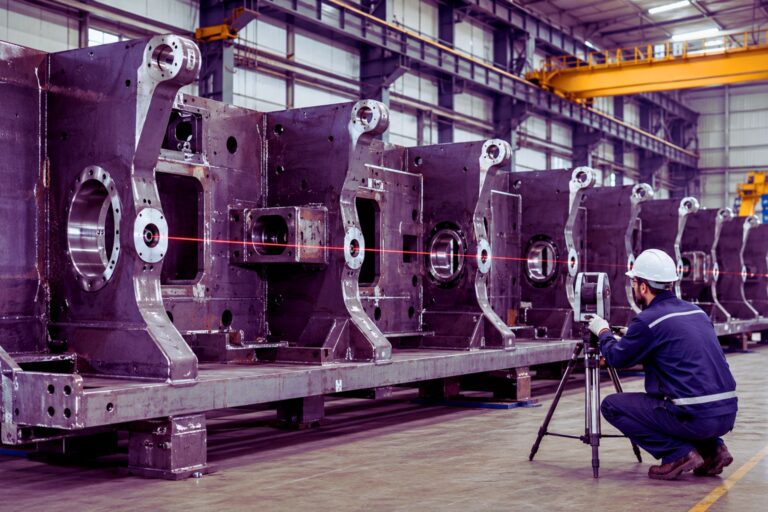
- Laser measurement or total station for large structures and interfaces
- Simple jigs and go/no-go gauges for repetitive features
Key point: You do not need advanced metrology everywhere. You need repeatable, fast measurement on the features that drive acceptance.
5) Typical distortion failure modes and how to prevent them
Angular distortion at fillets and T-joints
- Prevent with balanced welding, controlled leg size, and appropriate restraint
- Use shorter segments and alternate patterns where practical (twi-global.com)
Bowing and longitudinal shrinkage on long seams
- Segment long welds, apply skip and back-step logic
- Use restraint and sequencing to distribute heat (twi-global.com)
Misalignment across assemblies (accumulated error)
- Establish datums early, fixture interfaces, and measure after tacking
- Do not postpone geometry verification until the end (NSRP)
Next steps: make distortion control part of supplier qualification
For OEMs and project teams, distortion control capability is best evaluated as a system, not as a promise. A practical supplier review should confirm:
- A defined fixturing and datum approach for your critical interfaces
- A documented sequencing plan for long seams and multi-pass joints
- In-process measurement checkpoints aligned to acceptance-critical features
- Evidence that the approach is repeatable across shifts and batches
If you are preparing an RFQ or qualifying a supplier for heavy weldments, SL Industries can support with fabrication planning, controlled welding execution, and measurement checkpoints aligned with acceptance-critical geometry. Contact us at +359 (82) 841345 or info@sl-industries.com.
Sources (selected)
- TWI technical guidance on welding distortion and fabrication techniques. (twi-global.com)
- EWI publication on controlling welding-induced distortion through modeling and sequence optimization. (EWI)
- National Shipbuilding Research Program training material highlighting fit-up, restraint, and rework prevention fundamentals. (NSRP)
- SteelConstruction.info guidance referencing EN 1090-2 tolerance practice and the use of ISO 13920 for heavily welded structures. (steelconstruction.info)